
Although my music has always been released under the name Higgs Boson, some of my published writing appeared under my own name, Kevin Whitaker. Many of these reviews and articles were published in national music and technology magazines, reflecting another side of the same creative journey—as a writer, reviewer and commentator on music and digital technology.
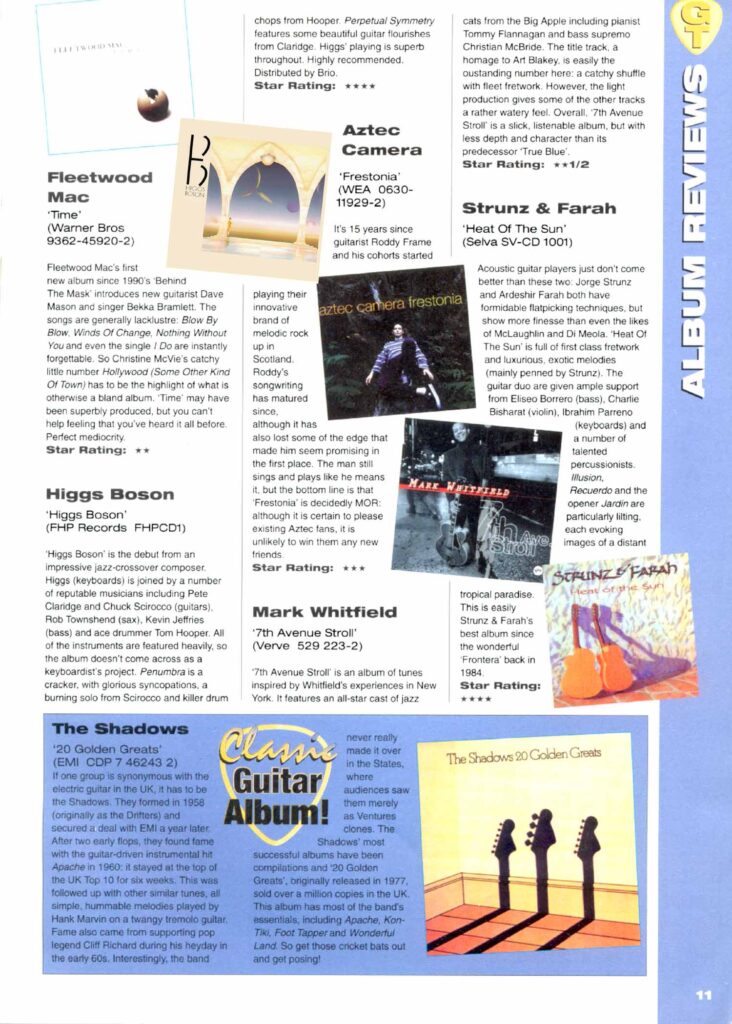
Higgs Boson – Higgs Boson
(FHP Records – FHPCD1)
Higgs Boson is the debut from an impressive jazz-crossover composer. Higgs (keyboards) is joined by a number of reputable musicians including Pete Claridge and Chuck Scirocco (guitars), Rob Townshend (sax), Kevin Jefferies (bass) and ace drummer Tom Hooper.
All of the instruments are featured heavily, so the album doesn’t come across as a keyboardist’s project. Penumbra is a cracker, with glorious syncopations, a burning solo from Scirocco and killer drum chops from Hooper. Perpetual Symmetry features some beautiful guitar flourishes from Claridge. Higgs’ playing is superb throughout.
Highly recommended.
Star Rating: ★★★★
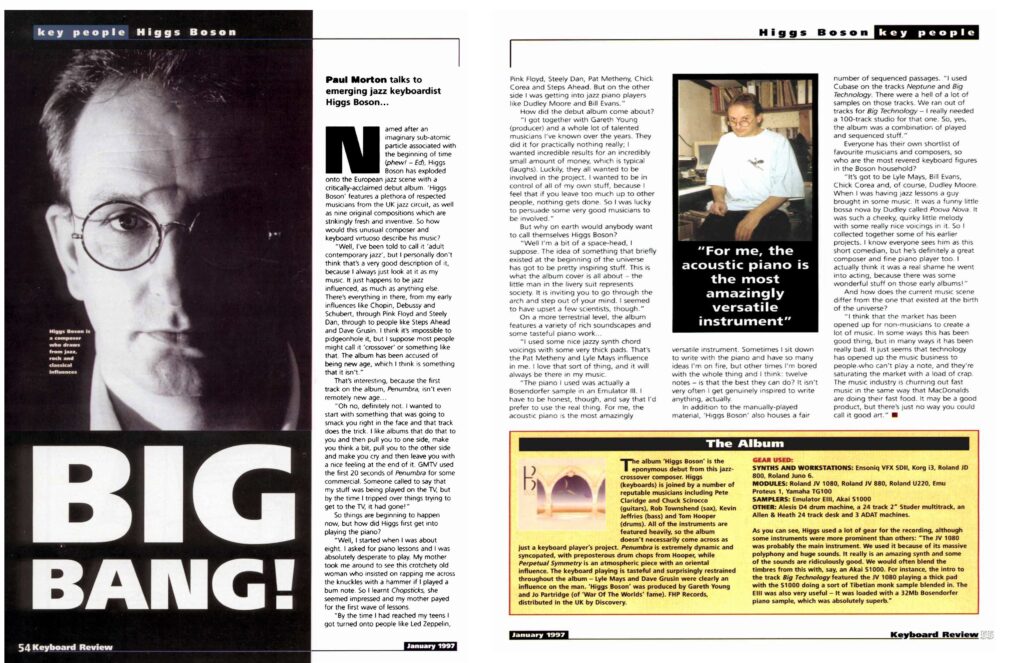
Keyboard Review
January 1997
Publication
Keyboard Review (UK)
Feature
Two-page interview with Paul Morton.
Two-page interview with Paul Morton.
Following the release of Higgs Boson, Keyboard Review featured an in-depth interview exploring the origins of the album, musical influences, recording techniques and the growing use of digital technology in jazz composition.
Reading it nearly three decades later provides an interesting snapshot of where I was as a musician in the mid-1990s. While much of the technology discussed has long since disappeared, the ideas behind the music—and my approach to composition—have remained remarkably consistent.
Transcript
The following is a transcript of the original interview, reproduced to make the text easier to read.
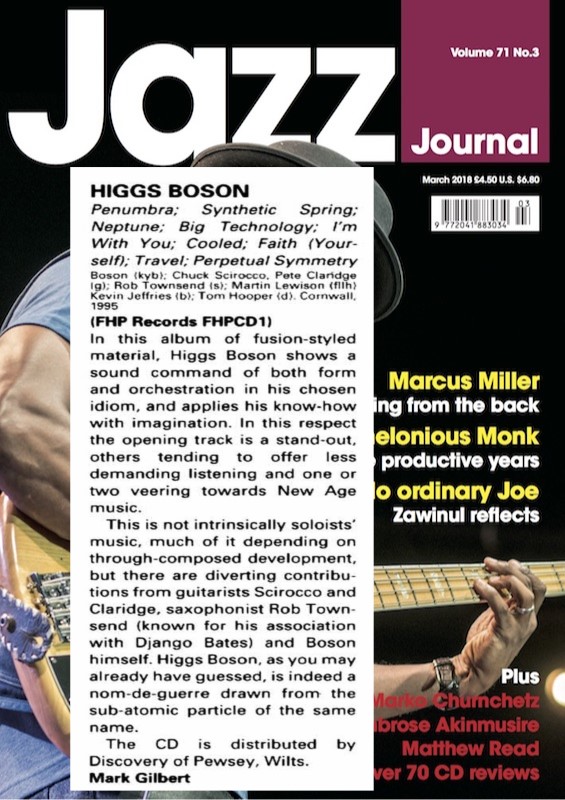
Jazz Journal review by Mark Gilbert.
Temporary scan — to be replaced when the original magazine copy is located.
Jazz Journal
Review by Mark Gilbert (later Editor of Jazz Journal).
Higgs Boson
Penumbra; Synthetic Spring; Neptune; Big Technology; I’m With You; Cooled; Faith (Yourself); Travel; Perpetual Symmetry
Boson (kyb); Chuck Scirocco, Pete Claridge (g); Rob Townshend (s); Martin Lewison (flh); Kevin Jefferies (b); Tom Hooper (d). Cornwall. 1995
(FHP Records FHPCD1)
In this album of fusion-styled material, Higgs Boson shows a sound command of both form and orchestration in his chosen idiom, and applies his know-how with imagination. In this respect the opening track is a stand-out, others tending to offer less demanding listening and one or two veering towards New Age music.
This is not intrinsically soloists’ music, much of it depending on through-composed development, but there are diverting contributions from guitarists Scirocco and Claridge, saxophonist Rob Townshend (known for his association with Django Bates) and Boson himself. Higgs Boson, as you may already have guessed, is indeed a nom-de-guerre drawn from the sub-atomic particle of the same name.
The CD is distributed by Discovery of Pewsey, Wilts.
Mark Gilbert
Editor’s note (2026): This review was published before the Higgs boson particle was experimentally confirmed at CERN in 2012. The stage name “Higgs Boson” was adopted many years earlier, inspired by the hypothetical particle proposed by physicist Peter Higgs in 1964.
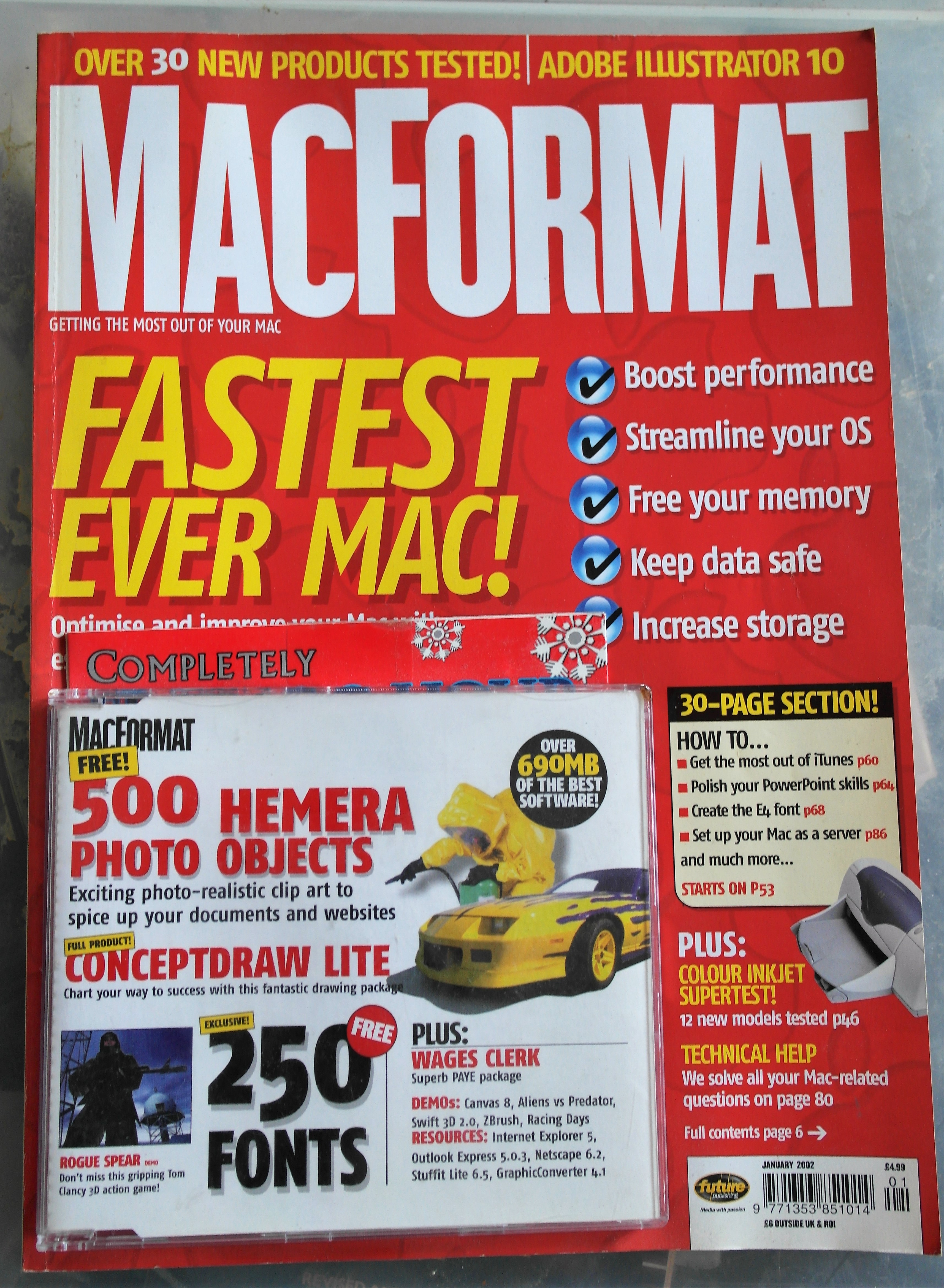
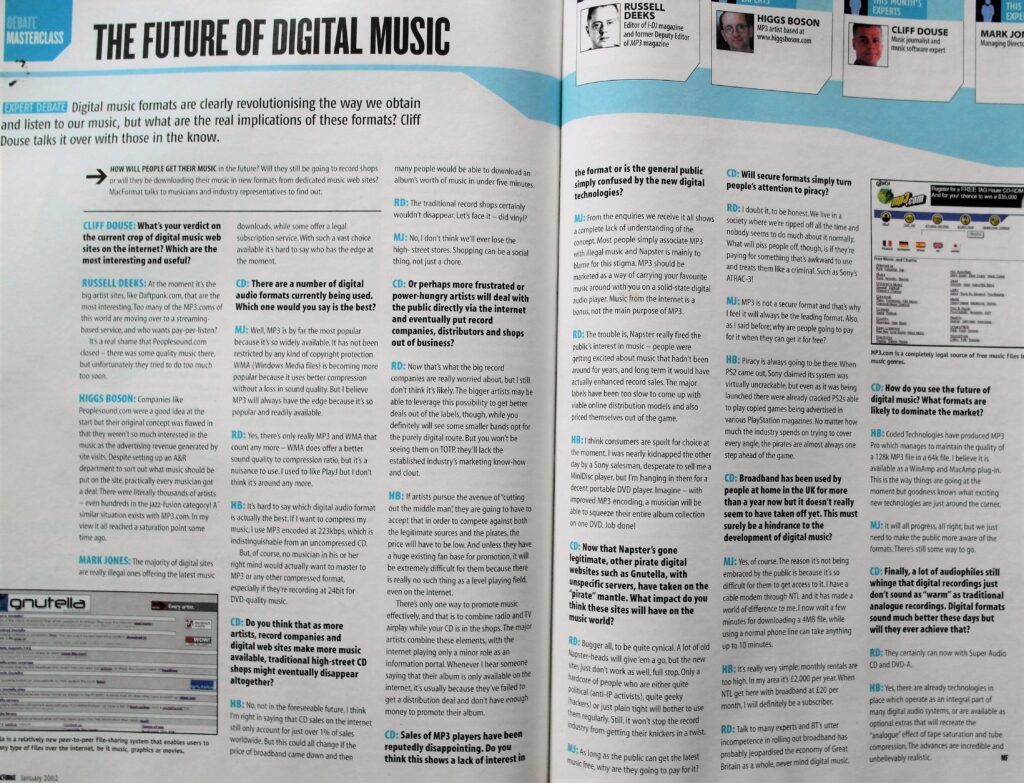
MacFormat Interview (January 2002)
In January 2002, MacFormat magazine’s Cliff Douse interviewed Higgs Boson about the future of digital music. The interview formed part of a feature comparing the views of a number of musicians and industry figures on subjects including MP3 technology, online distribution, piracy and the future of the music business. The transcript below contains Higgs Boson’s complete interview as it appeared in the magazine.
The Future of Digital Music
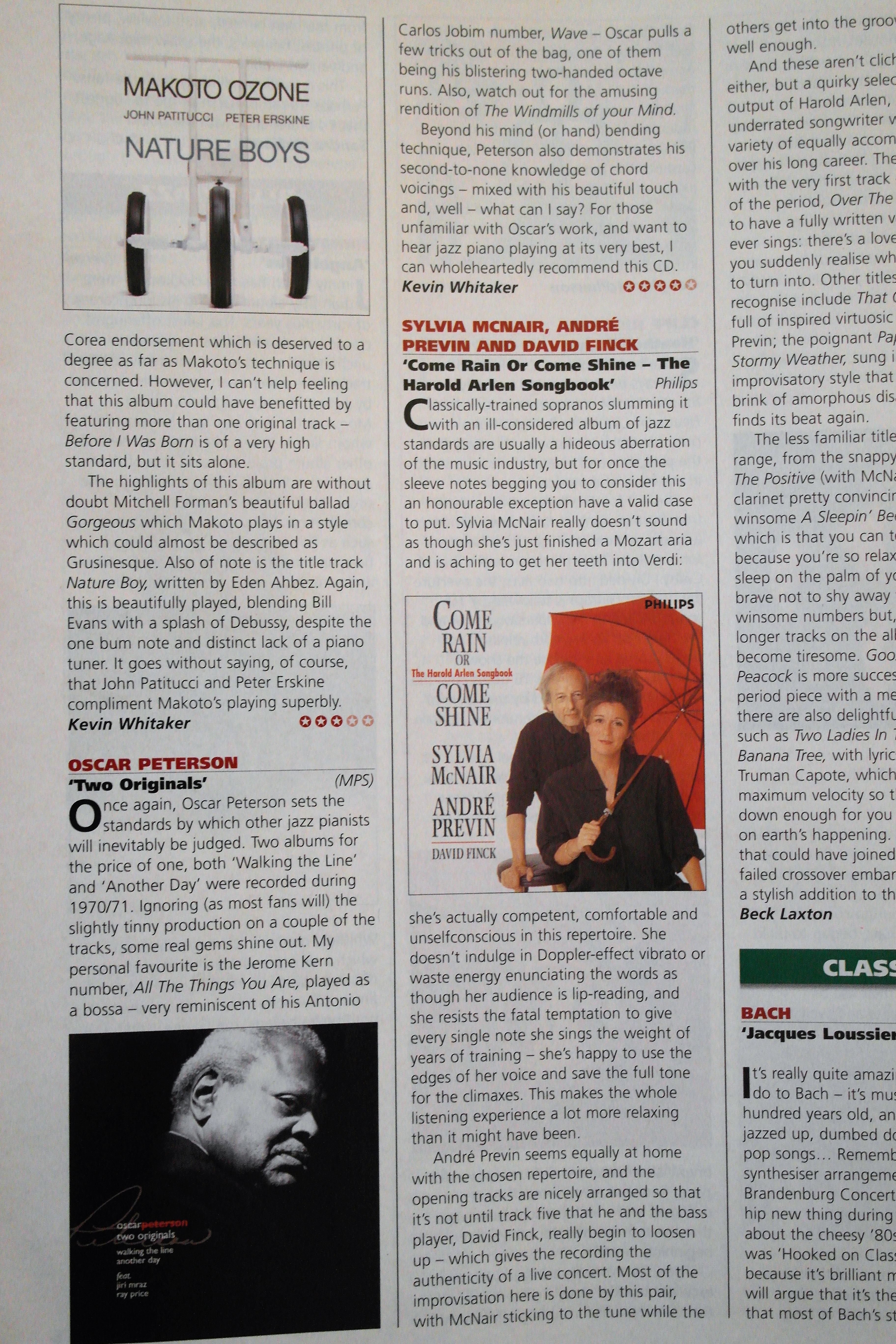
OSCAR PETERSON
‘Two Originals’ (MPS)
Once again, Oscar Peterson sets the standards by which other jazz pianists will inevitably be judged. Two albums for the price of one, both ‘Walking the Line’ and ‘Another Day’ were recorded during 1970/71. Ignoring (as most fans will) the slightly tinny production on a couple of the tracks, some real gems shine out.
My personal favourite is the Jerome Kern number, All The Things You Are, played as a bossa – very reminiscent of his Antonio Carlos Jobim number, Wave – Oscar pulls a few tricks out of the bag, one of them being his blistering two-handed octave runs. Also, watch out for the amusing rendition of The Windmills of Your Mind.
Beyond his mind (or hand) bending technique, Peterson also demonstrates his second-to-none knowledge of chord voicings – mixed with his beautiful touch and, well – what can I say? For those unfamiliar with Oscar’s work, and want to hear jazz piano playing at its very best, I can wholeheartedly recommend this CD.
Kevin Whitaker
★★★★★
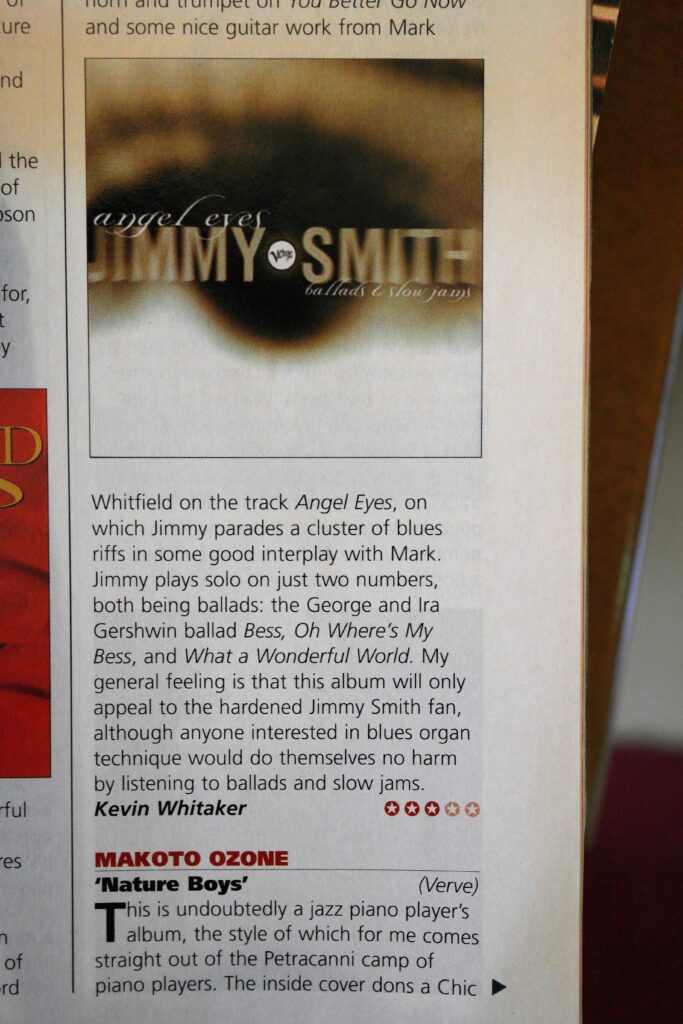
JIMMY SMITH
‘Angel Eyes – Ballads & Slow Jams’ (Verve)
Jimmy Smith is still capable of producing the sort of organ sound that has inspired generations of musicians, and there is some nice guitar work from Mark Whitfield on the track Angel Eyes, on which Jimmy parades a cluster of blues riffs in some good interplay with Mark.
Jimmy plays solo on just two numbers, both being ballads: the George and Ira Gershwin ballad Bess, Oh Where’s My Bess, and What a Wonderful World.
My general feeling is that this album will only appeal to the hardened Jimmy Smith fan, although anyone interested in blues organ technique would do themselves no harm by listening to Ballads & Slow Jams.
Kevin Whitaker
★★★☆☆
MAKOTO OZONE
‘Nature Boys’ (Verve)
This is undoubtedly a jazz piano player’s album, the style of which for me comes straight out of the Petracanni camp of piano players. The inside cover dons a Chick Corea endorsement which is deserved to a degree as far as Makoto’s technique is concerned. However, I can’t help feeling that this album could have benefited by featuring more than one original track – Before I Was Born is of a very high standard, but it sits alone.
The highlights of this album are without doubt Mitchell Forman’s beautiful ballad Gorgeous, which Makoto plays in a style which could almost be described as Grusinesque. Also of note is the title track Nature Boy, written by Eden Ahbez. Again, this is beautifully played, blending Bill Evans with a splash of Debussy, despite the one bum note and distinct lack of a piano tuner.
It goes without saying, of course, that John Patitucci and Peter Erskine compliment Makoto’s playing superbly.
Kevin Whitaker
★★★☆☆
Articles & Opinions
Alongside my published reviews and editorial work, I have also written a number of longer opinion pieces on music, the recording industry and related subjects. These articles reflect my personal observations and experiences as an independent musician and are presented here as part of the Higgs Boson archive.
Spotify and the Independent Musician