
From a weaver’s son in Dumfriesshire to Crimea, India and the beginnings of the Johnstone family at Aldershot.
James Johnstone was born at Hoddom, near Ecclefechan, Dumfriesshire, on 16 December 1832, the son of Richard Johnstone and Esther Paterson. He came from a family whose roots in the district stretched back generations. His grandfather, another James Johnstone, was a blacksmith in Ecclefechan, but by the time James was born his father Richard was working as a weaver.
James’s childhood appears to have been far from easy. In 1841, while James was still a boy, his father was recorded in Dumfries Prison. Seven years later Richard was again before the courts. On 30 September 1848, when James was fifteen, Richard Johnstone was convicted at the Dumfries Court of Justiciary and sentenced to seven years’ transportation. Another surviving prison record describes him as a weaver and records the offence as the theft of potatoes.
Whatever effect his father’s imprisonment and sentence had upon the young James cannot now be known. But the surviving records reveal a family living through difficult times, and James was soon to choose a very different life.
On 6 January 1853, aged twenty, he crossed the border into Cumberland and enlisted in the 79th Regiment of Foot at Whitehaven. Like his father, James gave his occupation as weaver.
Within little more than two years, the young Scottish weaver was serving in the Crimea.
It was the beginning of an extraordinary military career. James would serve for more than twenty-one years, spend many years overseas, fight in the Crimean War and serve in India during the uprising of 1857–58. His surviving Army papers record his campaign medals and provide an unusually detailed account of a Victorian soldier’s life.
By 1861 he was back in Britain and stationed at Aldershot, the rapidly developing home of the British Army. That apparently simple posting would have a lasting significance for the family. Aldershot became part of the Johnstone story, and almost forty years later James’s grandson, Alfred Sinclair Johnstone, would be born there.
James eventually left the Army in 1876. By then the weaver’s son from Dumfriesshire had travelled thousands of miles, survived two of the defining military campaigns of the Victorian age and established the foundations of the family whose photographs, documents and stories form the Johnstone Archive.
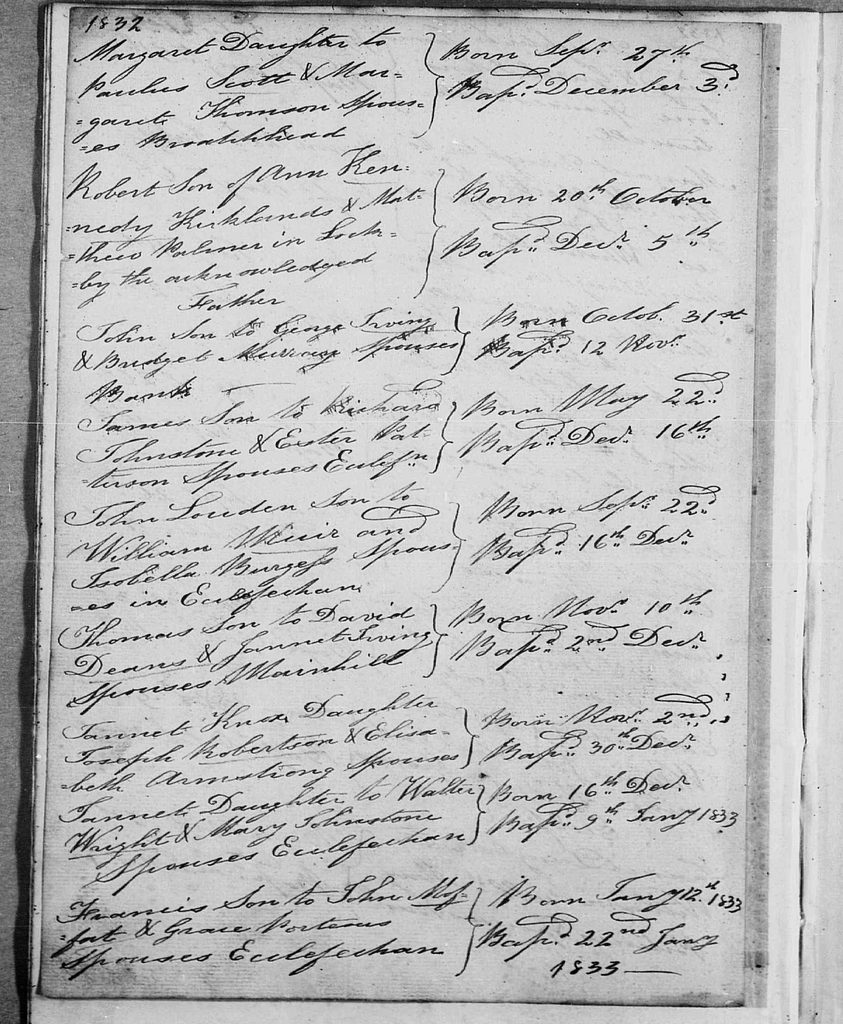
Parish record for James Johnstone, 1832.
Recorded as born at Ecclefechan on 22 May 1832 and baptised at Hoddom on 16 December 1832, the son of Richard Johnstone and Esther Paterson.
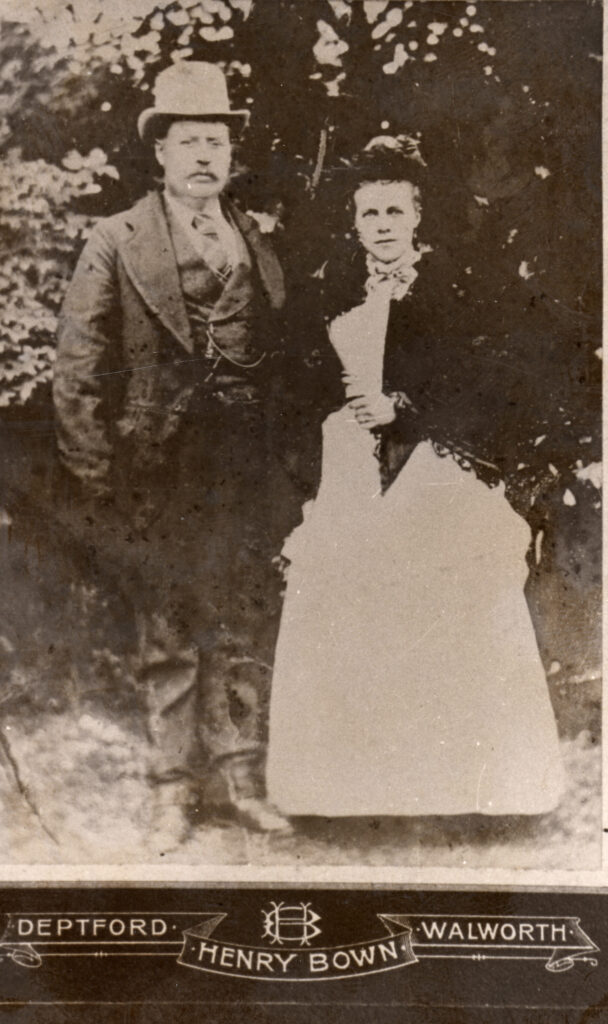
James Johnstone (1832–1908) and Eliza Hornett (1852–1930) on their wedding day, 21 October 1874. Studio portrait by Henry Bown of Deptford and Walworth. One of the earliest surviving photographs in the Johnstone Archive.