
Editors Note (2026)
This article was written during my early experiences of releasing music on Spotify. Some figures and platform features have changed since then, but I have left the article substantially as written because it reflects the challenges many independent musicians faced during the transition from social media to streaming.
Spotify and the Independent Musician
To anyone over the age of 50 the music business has changed beyond all recognition – and things change at an alarming rate too. In fact it’s become very difficult even for youngsters to adapt; and that I’m afraid is the key to it all, the ability to constantly adapt to change – that, and an immense amount of luck, and of course, some talent!
Having said that, it is clear to me that the indie musician stands at the bottom of a very steep curve when it comes to promoting their music.
Back in the good old days when MySpace reigned supreme and I was the number one jazz fusion act on the planet, for three years in a row, ah those were the days; at one point I was selling albums to Eskimos in Alaska. I had 150k active MySpace followers – these days I would be lucky to top a chart in my own house!
Now, there was a reason for my success – I cheated, not a lot, a bit, I used a simple program that automatically sent friend requests (usually about 250 per day) together with a short message which made a very effective marketing tool. With this simple program I could target the fans of any band with ease. The potential fan would see said request, hopefully click on it, play a few tracks and even comment. One of my tracks ‘Big Technology’ had 48,000 plays and 15,000 genuine comments. Other more successful artists such as Jean Luc Ponty were nowhere on MySpace compared to me.
When it started, MySpace was, what I would call, a completely open system where the indie musician stood a chance. Spotify on the other hand is a very different kettle o’ fish. To be listed on Spotify you have to go through a third-party distributor. On this network, I am quite literally nowhere. To be fair though, it is early days.
Anyway, a cursory glance at other artists reveals an alarming disparity between myself and other bands. So, I’ve done a mini study and something decidedly weird is afoot. Jean Luc Ponty for instance has 54,000 fresh monthly listeners, 34k followers and most of his tracks have half a million or so plays. Ok, fair enough but, take a closer look at his fan-base, most of which are from South America – Santiago to be precise. Now, a few weeks back I boosted a Facebook page post and received 750 likes, all from Brazil, so l looked at other acts on Spotify and something quite interesting was revealed – even Pink Floyd’s main listener base is South American, where? Well, Santiago of course, where else?
One positive thing that Spotify have done is the creation of their Spotify for Artists stats facility. Once registered you can update your profile and, more importantly, scrutinise not just your own stats but the basic stats of other bands/artists.
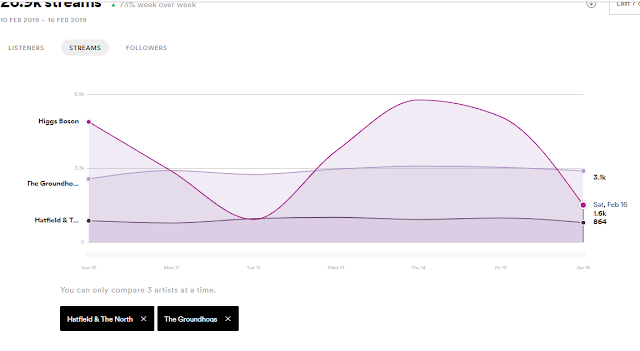
The above graph is from my Spotify for Artists stats page – it compares my weekly stream count with that of Hatfield & The North and The Groundhogs. As you can see, due to promotion, mine shows a degree of fluctuation – to me, this is normal. However, the other two shows a flat-line, no fluctuation at all – surely such consistency cannot be credible. And it’s not just them, the same applies to quite a number of other signed bands, which surely suggests that Spotify permit this activity. Sting for example, last time I looked, was getting 10 million listeners per month, really? He certainly wasn’t doing that well on Myspace, nothing like it.
In my view, unless you are signed to a major publisher it is nigh-on impossible to get on any official Spotify playlist. Further: in relation to Spotify’s ‘Fans Also Like’ (FAL) section – this is where your music is associated with other bands – they say that this selection is automatic and is basically arranged by algorithms.
With that, because the bands on my page were totally incompatible with my music, I contacted someone on LinkedIn who claimed to work for Spotify as a curator – I asked them if they could place one or two of my tracks on their playlist but also if they could change my FAL section to better reflect my music – she said she’d ask. Within two days Frank Zappa, Steely Dan, Camel et al appeared on my Spotify page as bands that my fans also liked. I was momentarily delighted. Fast-forward a couple days and I noticed that my FAL page had disappeared altogether. I queried this and was told that my Spotify account was suspected of fraudulent streams. Now, it was true that I had employed the services of a promoter who claimed to work with 2000 genre specific playlists – as it turned-out, this claim was untrue and as a result my music was being placed on playlists that included some really awful explicit material. I have since been refunded some of the money but the damage has been done. However, getting back to the FAL issue, another thing you’ll notice is that they, mainly signed acts, are all interconnected – in my view, that’s no algorithm. Given that the Spotify person I contacted was able to connect me with Frank Zappa etc. at will, they are clearly making editorial decisions about who they support – and I’m afraid it’s not the indie musician.
I don’t claim to know how the fake streamers are doing it – I assume a bot of some sort or perhaps they do actually have people playing the stuff but not really listening – it could be being used as background music in a public place, which if so, still breaches the Spotify Terms & Conditions. However, if they are doing that, they could split their income with those playlist users and still do better financially than the artist.
At a glance, the numbers are as you might expect, not exactly encouraging, certainly not good for a nowhere boy like me. To start with, an artist is purported to get about £4 per thousand streams. That means to recoup my recent £40 ad splurge on Facebook I’ll need 10,000 streams. Only 9,500 to go then – worth noting that it’s taken me about 4 weeks to get those 500 plays and has earnt me £2. Actually the news is grim – Spotify are only paying me £1.17 per 1000 streams. I have asked my distributor Ditto Music to explain but they remain silent on the issue.
For what it’s worth, my somewhat opinionated conclusion is that, to all intents and purposes, Spotify operates like a cartel—a protection racket configured to heavily favour large multinational publishers, not unlike the BBC, which is taxpayer funded. Sure, you can advertise – they’ve launched Ad Studio but there’s an annoying catch – you need to be VAT registered – I don’t personally know any VAT registered musicians; most live hand-to-mouth. In any case, to justify the kind of expenditure suggested you would literally need tens of millions of streams.
Take, for example, the widely reported dispute between Peter Frampton and Spotify over streaming royalties. Apparently, for 55 million streams of ‘Baby I Love Your Way’ he only got $1700. I worked out that for me to make 1700 on Spotify I would need approx 1.1 million streams – so although signed acts are paid a higher rate, they fair much worse. I assume that that is because they have to share the royalty with a record company, their publisher, and any co-writers.
Ditto Music have now told me that depending on the territory the average royalty rate from Spotify is about £3.00 per 1k streams – not sure how they determine that when my own rate paid through them is in fact much less. The problem is that you hear wildly different accounts. Digital Music News (DMN) reported that a “successful indie artist” who owns 100% of his publishing and masters reportedly made “€3,765.01, or $4,432.58” on a million streams. Don’t tell Peter Frampton, or me for that matter. They must be attracting those elusive Sultan of Brunei streams?
So, do cheats prosper? Answer, it depends. Yes, you can buy followers, plays, monthly listeners etc. but the cost is prohibitive e.g. £4.99 for 1000 streams. When the royalty is only £1.17 per thousand, bankruptcy is but just around the corner. The reality is that it’s simply not profitable for the musician whether he/she be signed or not. They offer “organic” promotion, which as far as I can tell, is utter nonsense. They offer “viral promotion” = is it f**k. As for “genre specific playlists” truth is your stuff is mixed with a plethora of explicit material, and not only that; once Spotify get wind of it you’ll either get banned or removed from their algorithmic system altogether – meaning that you will languish in obscurity forever.
If you can find a music promoter that can procure 1k genuine streams for £0.50p, you’ll be in the zone – good luck with that. Alternatively you could spend several lifetimes networking on social media, begging people to play your stuff – good luck with that too. There’s always Facebook ads, a great facility, has some really good tools for targeting specific people in any given location. However, I reckon it would be easier to sell one-way tickets to the Dignitas clinic than get them to migrate from one platform to another.
The reality is that promoting your own music online can be thoroughly soul-destroying. The independent musician is expected to write the songs, make the recordings, finance the releases, market the albums and somehow compete with multinational publishers possessing resources that most of us can scarcely imagine. Whether the system is broken or simply stacked against the little guy, I’ll leave others to decide. All I know is that making the music has always been considerably easier than persuading people to hear it.
Tootle-pip
Higgs Boson